Home Blog Page 17

Reds destroy 6 heavy equipment in Surigao Norte

BUTUAN CITY – Around 20 fully armed New People’s Army (NPA) rebels torched and destroyed six units of heavy equipment owned by the contractors of Platinum Group Mining Corporation (PGMC) Thursday afternoon in Sitio Kinalablaban, Barangay Cagdianao in Claver, Surigao del Norte.

Surigao del Norte Police Provincial Office (SDNPPO) director, Col. Noel Espinoza, in a statement Friday, said the perpetrators were led by a certain “Jacob” of Sandatahang Yunit Pampropaganda 16C, Guerrilla Front 16, North Eastern Mindanao Regional Committee of the NPA.

The heavy equipment units destroyed include four backhoes owned by Cagdianao Construct Development Corporation and two other backhoes owned by Queens Contractor.

The local police station in Claver is still determining the total cost of the damage as of press time.

“The SDNPPO strongly condemns the Communist Terrorist Group (CTG) for the burning of heavy equipment,” Espinosa said.

He added that intelligence units from Claver town were already directed to conduct intensified information gathering in the area.

Nearby municipal police stations, including in Siargao Island, as well as mining plants in the area, were also alerted for possible diversionary attack from the NPA rebels, he said.

“The CTG’s activity is a proof of their motive to pursue their lawless purpose, contrary to their claim of protecting the people,” Espinosa said.

He added that SDNPPO is also conducting an in-depth investigation for the possible identification of the perpetrators for prosecution.

The Communist Party of the Philippines-NPA is listed as a terrorist organization by the United States, the European Union, the United Kingdom, Australia, Canada, and New Zealand. (PNA) 

NPA killed Absalon due to his promotion of sports: Esperon

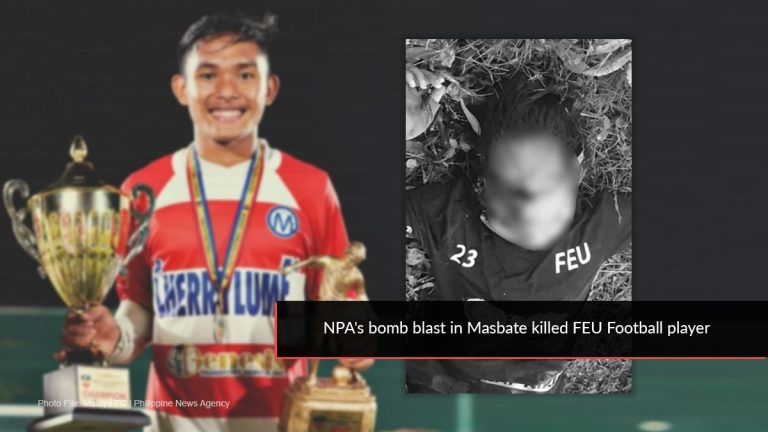
MANILA – Kieth Absalon, the football player from Far Eastern University (FEU) who was killed on June 6 in a New People’s Army (NPA) attack in Masbate, was specifically targeted due to his popularity and active promotion of sports among the youth that was contrary to the advocacy of communist terrorist groups (CTGs).

This was revealed by National Security Adviser Hermogenes Esperon Jr. at the recent virtual presscon of the National Task Force to End Local Communist Armed Conflict (NTF-ELCAC).

“Why? Because they found out that Kieth is actively promoting sports and activities for the well-being of the youth na kontra sa adbokasiya ng (That is contrary to the advocacy of) CPP (Communist Party of the Philippines)-NPA-NDF (National Demovcratic Front),” Esperon said.

He said the CPP-NPA-NDF also “want to show that they are still a force to reckon with, as many of their members have continued to surrender in Masbate.”

“Parang pananakot talaga ito sa tao, at yung pananakot na iyan ay sinamahan nila ng pagpatay. Kaya targeted talaga sila (It really seemed like a threat to the people, and that threat was accompanied by murder. So they are really targeted). Meaning they wanted to deliver a message to intimidate the population from whom they are losing support,” added Esperon, also the NTF-ELCAC Vice Chairperson.

He mourned for the loss of the FEU football player who was awarded the University Athletic Association of the Philippines (UAAP) Juniors Most Valuable Player in Season 78.

“We join the Absalons in their grief for their loss of a son and nephew in this unfortunate incident in Masbate. Nakakagulat talaga yung nangyari kina Kieth. Parang walang karason-rason at sa maling rason ay nawala isang kabataan na sana ay magbibigay ng isang magandang kinabukasan sa kanayang pamilya (What happened to Kieth was shocking. There was no any reason and for the wrong reason, a youth who would hopefully give his family bright future, was lost),” Esperon said.

He, however, assured the Absalon family that the Regional Task Force (RTF) in Bicol has already filed cases in court against the CPP-NPA-NDF and its key personalities for summarily executing Kieth and his cousin, Nolven, after blasting them with the banned anti-personnel mine (APM) last June 6 while biking.

“At ito nga ang pinaglalaban natin at tinutulungan natin ang pamilyang Absalon. At para dito ay sinasamahan tayo ng maraming nakikiisa sa atin hindi lang dito sa NTF-ELCAC (And this is what we are fighting for and we are helping the family of Absalom. And for this we are joined by many who join us not only here at NTF-ELCAC),” he said.

Meanwhile, Esperon pointed out that the RTF in Eastern Visayas will also be filing cases against the CTGs that killed and injured scores of unarmed soldiers and militiamen with another Anti-Personnel Mine (APM) in Jipapad, Eastern Samar on July 7.

He said the Jipapad incident only proves the continuing atrocities of the CTGs.

“Nakita natin kung gaano kalaupit at walang rason na violence na ginagawa ng (We have seen how cruel and unreasonable violence is committed by) CPP-NPA-NDF,” he said.

Esperon also acknowledged the move of the Commission on Human Rights (CHR) to condemn the violence committed by the NPA rebels.

“Just like us, the NTF-ELCAC, they are against violence, especially the violence carried out by an unreasonable ideology—which has gone out of control and gone out of reason for its existence. Kaya nga ang sinasabi natin ay dapat tuldukan na ito. At magsamasama tayo para sa madaling panahon ay matapos natin (That is why we are saying, we should stop this violence. Let’s unite so that we will end this as soon as possible),” Esperon said.

The CPP-NPA is listed as a terrorist organization by the United States, the European Union, the United Kingdom, Australia, Canada, New Zealand, and the Philippines. (PR)

Dawlah Islamiya leader slain, 2 arrested in Maguindanao

CAMP SIONGCO, Maguindanao – A leader of the local terrorist group Dawlah Islamiya (DI) was killed while two others were captured during a law enforcement operation in Maguindanao, the military here reported Sunday.

Lt. Colonel Benjamin Cadiente, commanding officer of the Army’s 33rd Infantry Battalion (IB), identified a slain terrorist leader during the focused military operation on Saturday only through his alias as “Tong Bomber”, a bomb expert responsible for attacks against military convoys and installations in the province.

Members of the DI (Islamic State) in Maguindanao are remnants of the Maute terror group that carried out a siege in Marawi City in 2017.

“He was killed following the 7 a.m. encounter in Barangay Nabundas, Shariff Saydona Mustapha town,” Cadiente said in his report to Maj. Gen. Juvymax Uy, the Army’s 6th Infantry Division commander and head of Joint Task Force Central.

He added that the 33IB troopers were met with gunfire while approaching the location of the group, triggering a firefight.

“After the smoke cleared, Tong Bomber was seen lying dead with his rifle beside him,” Cadiente said.

Two other cohorts of the slain target, identified as Nondo Sangalan and Tong Sangalan, peacefully surrendered.

Seized from them were one M14 rifle, ammunition, and two improvised explosive devices, similar to those set off by members of Bangsamoro Islamic Freedom Fighters (BIFF), another local terror group, in civilian and military targets in Maguindanao.

Cadiente said a government trooper was slightly injured in the clash and is now confined at Camp Siongco Station Hospital.

The remains of the neutralized terrorist were immediately turned over to the barangay officials of Barangay Nabundas, while the captured suspects were placed under the custody of the Shariff Saydona Mustapha authorities for the proper filing of cases.

Uy, for his part, lauded residents in reporting the presence of the terrorists in their midst that prompted the 33IB to conduct the operation.

“Your actions have saved countless lives that could have been victims of these suspected terrorists,” Uy said.

For the past 12 months, more than 50 DI and BIFF terrorists have been neutralized in Maguindanao, while over 100 others have opted to peacefully surrender to live normal lives.

source: (PNA)

Graduating Taguig Grade 12 students get P15K scholarship

MANILA – Graduating Grade 12 students in Taguig City’s public schools received PHP15,000 worth of scholarship vouchers each for use in their chosen schools for college.

Mayor Lino Cayetano, in a statement Monday, said the voucher certificate entitles the bearer to claim the amount of PHP15,000 under the Lifeline Assistance for Neighbors In-Need (L.A.N.I.) scholarship program, provided that the student enrolls in any tech-voc, certificate or baccalaureate course.

“This voucher is part of the L.A.N.I scholarship program that persuades graduates to take up tertiary education. To our beloved students, we have faced so much this year, let us get inspiration from this graduation. We will not abandon you. We are a loving and nurturing community, we are one family,” he added.

All Top 1 graduating students from Grades 6, 10 and 12 also received a cash incentive of PHP15,000, while the Top 2 students received PHP12,500.

Top 3-10 elementary students also received PHP5,000 each while completers and senior high students received PHP7,500 each.

Top 1 students in each elementary class also received PHP2,500, while Top 1 completer and senior high students from each class received PHP5,000.

As of April this year, the city has produced more than 58,000 scholars and continues to accept eligible applicants. 

source: (PNA)

Sandiganbayan affirms dismissal of P267 million Marcos forfeiture case

The Sandiganbayan 4th Division has affirmed its dismissal of a civil case involving the forfeiture of P267 million of alleged ill-gotten wealth of the family of the late strongman Ferdinand Marcos and spouses Fe and Ignacio Gimenez.

In a resolution promulgated on Jan. 23, 2020, the anti-graft court denied the motion for reconsideration filed by the Office of the Solicitor General (OSG) and the Presidential Commission on Good Government (PCGG).

In Civil Case No. 0007, the Republic of the Philippines had sought the forfeiture of millions of pesos and dollars siphoned off to foreign countries, expensive works of art, as well as real estate properties under the name of the Gimenezes.

The forfeiture case was dismissed last year due to photocopied and defective evidence, which the court said was fatal to the case.

“In the present case, the court again emphasizes that the defects that were discovered n the Republic’s exhibits during their evaluation had the effect of greatly diminishing the said exhibits’ probative value,” the court said in the decision penned by Division Chairperson Alex Quiroz, with the concurrence of Associate Justices Reynaldo Cruz and Maria Theresa Mendoza-Arcega.

The court also said it was not convinced that the assets of the Gimenezes are manifestly disproportionate to their source of income.

It was also pointed out that prosecution witnesses have no personal knowledge of the contents of the documents they identified in court.

The court added that the Supreme Court decision on having a liberal approach on technical procedures was only with respect to the reception of evidence.

“Indeed, arguing that a liberal approach should likewise be made in the evaluation and appreciation of the Republic’s evidence would appear to go against the very basic tenet that courts of law are duty bound to act with impartiality in the performance of their task of rendering justice,” the court said.

Marcos civil case involving estate of late businessman Ricardo Silverio junks by Sandiganbayan

The Sandiganbayan 4th Division has dismissed a civil case involving former First Lady Imelda Marcos and the estate of late businessman Ricardo Silverio for the failure of the Philippine government to present evidence on alleged ill-gotten properties during the Marcos regime.

In a decision promulgated on June 30, 2021, the anti-graft court said the government failed to fully present its evidence and prove the allegations in the complaint for reconveyance, reversion, accounting, restitution and damages filed on July 22, 1987 by the Presidential Commission on Good Government against Silverio, Pablo Carlos, Jr. former President Ferdinand Marcos and his wife Imelda.

“Plaintiff miserably failed to do so as plaintiff’s evidence did not preponderantly show that the various business interests of defendant Silverio have enjoyed considerable grants and privileges obtained from defendant Ferdinand Marcos during his tenure as chief executive and such privileges could not have been so obtained were it not for the close association of defendant Silverio with Ferdinand Marcos,” the court said in the decision.

ALSO READ: Sandiganbayan affirms dismissal of P267 million Marcos forfeiture case

The decision was penned by Division Chairperson Alex Quiroz, with the concurrence of Associate Justices Lorifel Pahimna and Edgardo Caldona.

The case involved 17 real estate properties including parcels of land and condominium units in California and a 28-unit apartment in Ecology Village in Makati City.

Also questioned by the PCGG were personal properties such as shares of stock in Silcor Finance, USA, Inc., Astroair Services, C&M Timber, Air Manila, and Delta Motors Corporation.

In the complaint, the PCGG alleged that Silverio and Carlos, Jr. took undue advantage of their relationship with the Marcoses as they acted as “dummies, nominees and agents” of the couple.

The PCGG said that the Marcoses received kickbacks in hundreds of thousands of US dollars in exchange for an award to Silverio of Kawasaki Scrap Loaders and Toyota Rear Dump Trucks.

The businessmen also supposedly received exemptions by the then Central Bank of the Philippines in the form of increased dollar import quota allocation for the importation of Toyota vehicles for Delta Motors, Inc.

During trial, Silverio maintained that he was a legitimate businessman and all import quota allocations and credit facilities extended to him were in accordance with sound banking practices.

ALSO READ: Sandiganbayan affirms dismissal of P267 million Marcos forfeiture case

Carlos, Jr. said that of all exhibits offered against him, an alleged letter of Silverio cannot be appreciated against him under the principle res inter alios acta.

In its decision, the court agreed that there was no evidence against defendant Estate of Pablo Carlos, Jr.

The court also said that while the complaint listed the properties, there was no showing as to the manner how Silverio and his co-defendants Pablo Carlos Jr. and Ferdinand Marcos illegally acquired the said properties.

“More importantly, there was no evidence presented to show that these properties were in fact owned by them and that the same were ill-gotten,” the court said. 

The court took note that the government offered the transcript of Silverio’s testimony in 1990 in United States vs. Imelda Marcos and Adnan Kashogi before the US District court Southern District of New York as one of the exhibits.

The transcript would supposedly show that Ferdinand Marcos ordered the Social Security System to approve the application of Silverio for a loan of P6 million in consideration of the former receiving shares in Delta Motors Corporation amounting to 20 percent of the corporation’s outstanding capital stock.

“Plaintiff submitted only a photocopy of the said transcript and the same was never compared to the original copy. The original and authenticated copy of the transcript was never submitted to the court,” the court said.

The court added that there is no legal basis for the prayer of the PCGG for the accounting of the properties and assets of whatever kind and wherever located in excess of their lawful earnings.

“As regard the parties’ claim for damages, the court cannot grant the same without evidence establishing entitlement to the same,” the court said.

ALSO READ: Sandiganbayan affirms dismissal of P267 million Marcos forfeiture case

Pilipinas, Nagsimula ng mag Export ng Okra sa South Korea

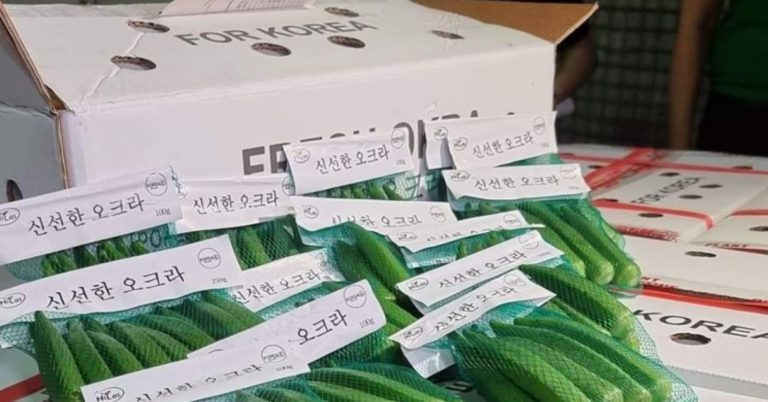
Okra or lady’s fingers will soon hit the Korean market as the Philippines starts exporting them for the 2021-2022 season after complying with the agreed requirements set by both countries.

“After the resumption of okra exports to Japan last year, we are opening yet another market access for our okra, this time with the huge Korean food market. The Philippine government has been requesting market access of okra to Korea since 2014 and finally, it was granted. This is a milestone for us considering we are still in the midst of the global pandemic,” said Agriculture Secretary William Dar.

The government of Korea announced the completion of the ruling process for the Philippine okra market access to Korea through an official notification from the Ministry of Agriculture, Food and Rural Affairs (MAFRA) on May 6, 2021, said DA Agriculture Attachè Aleli Maghirang in a report to Secretary Dar.

“I commend the efforts of concerned DA offices, particularly the Bureau of Plant Industry (BPI) and the Philippine Agriculture Office in Seoul, for this breakthrough and significant development that will also pave the way to more farm and fishery exports to Korea,” he added.

The DA chief said exports of fresh, green okra pods will be sourced initially from Tarlac province, where DA-BPI accredited farms and packing houses are located. Currently, there are four Philippine okra exporters, namely: Jelfarm Fresh Produce Enterprise; Greenstar Produce, Philippines Inc.; AAMC Foods Corp.; and Hi-Las Marketing Corp. All are members of the Philippine Okra Producers and Exporters Association (POPEA).

Maghirang said that due to the current pandemic-related travel restrictions, Korea’s MAFRA Animal and Plant Quarantine Agency (APQA) has requested the DA-BPI to conduct on their behalf appropriate investigations and provide inspection report in lieu of the required Korean on-site survey of the okra farms in Tarlac. Once the requirements are complied with, Philippine okra exports to Korea may commence, she added.

In Korea, Maghirang said okra is not as mainstream as radish, cabbage, cucumber, potato, and sprouts, which are parts of many Korean dishes. Some Koreans eat okra as “banchan” (side dish), including “okra muchim” (seasoned) or “okra kimchi” (pickled/fermented).

Okra is available only at the online market, as frozen or dried form. Processed okra products mostly imported from China, while the fresh, green pods are available in small volume, during summer season. These are mostly consumed by Filipinos and other Asian nationalities in Korea.

“This is therefore a good opportunity for us to enter the Korean food market and promote Philippine okra for mainstream consumers,” Secretary Dar said.

Okra has long been favored as a food for the health-conscious, as it contains potassium, Vitamins B and C, folic acid, calcium, and rich in amino acids. It prevents anemia, promotes healthy skin and pregnancy, prevents stomach ulcer, and improves the respiratory system.

Filipino farmers plant okra as it is a high-yielding crop and provides good source of income. Its green pods can be harvested as early as 55 to 65 days upon seeding. Surveys show that farmers can harvest 500 kilograms up to one ton of okra pods per hectare, providing them a net income, ranging from P80,000 to P120,000.

“The entry of Philippine okra to the Korean market is indeed a welcome development to boost not only the livelihood and incomes of our farmers, but also pave way to other potential export crops, thus invigorating the country’s agriculture sector,” the DA chief concluded. ### (Rita dela Cruz, DA StratComms)

Yakult to build new plant in Mindanao to boost output by 70 pct

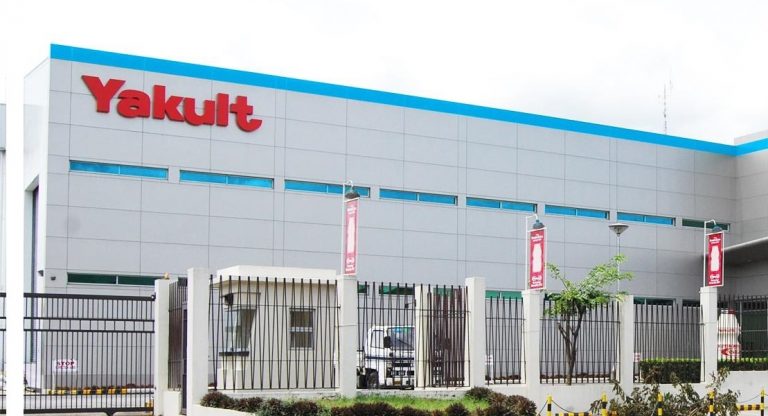
TOKYO – Yakult Honsha Co., a major food and beverage firm popularly known for its probiotic drink, will aim to meet brisk demand by building a new factory in the southern Philippines island of Mindanao, raising local output capacity by about 70 percent.

The Tokyo-based firm announced Monday that the new factory, to be constructed by its Manila-based equity-method affiliate, Yakult Philippines, Inc., in El Salvador in the province of Misamis Oriental, will start operations in January 2023 with a maximum daily production capacity of 3.2 million bottles of its mainstay Yakult and low-calorie Yakult Light.

The new plant, Yakult’s second in the Philippines, will sit on a plot of about 42,000 square meters, some 40 percent larger than its first plant in Calamba in Laguna province near the capital Manila.

Yakult did not publicly disclose the amount it will spend to build the plant, which will have a total floor space of about 26,000 square meters.

It will initially produce 1.6 million bottles of Yakult and Yakult Light daily, and the company plans to expand its facilities depending on demand.

Yakult’s combined daily output capacity in the Southeast Asian country will thus rise about 70 percent to a maximum of 7.9 million bottles.

“With the construction of a new factory, we can anticipate further market expansion and growing demand in the Visayas in the central Philippines and Mindanao in the south,” a Yakult spokesman told NNA.

Partly backed by growing health consciousness among Filipino consumers, sales in the Philippines soared 94.7 percent to 3.03 million bottles on a daily basis in 2020 over a year before.

The Philippines is Yakult’s fourth-largest overseas market after China with 7.01 million bottles, Indonesia with 6.73 million bottles and Mexico with 3.5 million bottles.

Yakult has promoted sales in the Philippines by deploying a sales force of about 3,800 “Yakult ladies.”

DOTr has ordered 240 train cars for the upcoming Metro Manila subway

THE Philippines broke ground on its first underground urban rail line on February 27, when a ceremony was held at Barangay Ugong in Valenzuela City to officially launch construction of the Metro Manila Subway.

The ceremony was attended by Japan’s ambassador to the Philippines Mr Koji Haneda and Department of Transportation (DOTr) secretary Mr Arthur Tugade.

The 36km first phase of the north-south line will run from Quirino Highway in Quezon City to Taguig and Ninoy Aquino International Airport Terminal 3, serving three of Manila’s business districts.

Last week the DOTr signed a design-build contract with joint venture of Shimizu Corporation, Fujita Corporation, Takenaka Civil Engineering and EEI Corporation for the initial three-station section from Quirino Highway to North Avenue, which is due to open in 2022. The remainder of the line will be completed in 2025.

The Department of Transportation (DOTr) has already shown off renders of the Metro Manila Subway, shared that it will be flood-proof, and even flaunted a gigantic tunnel boring machine. This time, though, we might just be about to buy into the hype the agency has been drumming up for the project.

Earlier today, December 22, the transport agency announced that it had ordered a total of 240 train cars for the upcoming Metro Manila Subway following a contract package signing between the Philippine government and the Sumitomo Corporation and the Japan Transport Engineering Company joint venture (JTRAC-Sumitomo).

The deal has a total approved cost of P367 billion for the “design, supply, installation, construction, testing, and commissioning” of train sets for the subway line. That’s for 240 train cars or 30 eight-car train sets.

“We will have 30 train sets for the subway alone. Indeed, the sustainable solution for our traffic congestion is the buildup of our mass transportation network,” DOTr undersecretary Timothy John Batan said in a statement, adding that the figure is already greater than the number of train cars the country had running back in 2016.

The Metro Manila Subway will consist of 13 stations stretching from Quezon Avenue all the way to Bicutan, and even up to Terminal 3 of the Nino Aquino International Airport (NAIA).

The first phase of the project, which is four stations from East Valenzuela to North Avenue, is already under construction and expected to be up and running by 2022, with the rest of the subway scheduled to become operational by 2026.

source: topgear

House of Representatives approved free annual medical check-up for Filipinos

MANILA – The House of Representatives on Tuesday overwhelmingly approved on third and final reading a measure providing for a free annual medical check-up for Filipinos.

With a vote of 245-0-0, the chamber passed House Bill 9072, otherwise known as the “Free Annual Medical Check-up Act”, which aims to enhance programs focusing on preventive and curative medicine that advance the health and well-being of Filipinos and prevent disease, disability, and death.

Under the bill, all Filipino citizens, by virtue of their membership in the Philippine Health Insurance Corp. (PhilHealth) mandated under Republic Act No. 11223 or the Universal Health Care Law, shall be entitled to the applicable benefits under the Philippine Health Insurance Program.

Members shall be entitled to a free annual medical check-up that shall include blood sugar and cholesterol tests.

Laboratory and diagnostic tests shall be expanded, subject to the availability of PhilHealth funds.

Anakalusugan party-list Rep. Michael Defensor said primary health care includes preventive care, to which medical check-ups fall under.

“This bill aims to secure that each Filipino shall be given the chance to have a free annual medical check-up to promote their right to health and health literacy,” Defensor said.

To promote health, identify risks, and ensure early diagnosis, PhilHealth shall establish a system that allows access to a free annual medical check-up and ensure that Filipinos shall be accorded the quality health care services that they deserve.

The amount n