A netizen snaps photos of her parents preparing food for health workers in Malolos, Bulacan despite having no income since the closure of their spot in the market due to the enhanced community quarantine. Salute, ma’am and sir! #Saludo#Covid19PH
and
And here is one of the opinion from netizen:
Mon BayIf the LGU is reading this, I would recommend it to be stopped. Medical workers should be protected. We understand and appreciate the intention but the most careful and sanitary preparation should be considered specially when providing them nourishment. If they get sick, what happens then?
The Duterte administration’s economic team announced Monday night a much-awaited spending plan amounting to P27.1 billion to arrest the spread of the new coronavirus and provide economic relief to sectors hammered by the pandemic.
“As directed by President Duterte, the government will provide targeted and direct programs to guarantee that benefits will go to our workers and other affected sectors,” Finance Secretary Carlos Dominguez said in a statement.
“We have enough but limited resources, so our job is to make sure that we have sufficient funds for programs mitigating the adverse effects of COVID-19 on our economy,” he added.
This fiscal support package crafted by the economic team includes:
The mobilization of an additional P3.1 billion to contribute directly to efforts to stop the spread of COVID-19, including the acquisition of test kits. The funds came from the Philippine Amusement and Gaming Corp. (Pagcor), Philippine Charity Sweepstakes Office (PCSO) and the Asian Development Bank (ADB);
P2.0 billion representing the initial budget set aside by the Department of Labor and Employment (DOLE) for social protection programs for vulnerable workers, to be used for wage subsidy/financial support to COVID affected establishments and workers;
Mobilization of an existing P1.2 billion in the Social Security System (SSS) to cover unemployment benefits for dislocated workers;
The Technical Education and Skills Development Authority (TESDA)’s Scholarship Programs amounting to P3 billion will support affected and temporarily displaced workers through upskilling and reskilling;
Various programs and projects of the Department of Tourism (DOT) amounting to P14 billion from the Tourism Infrastructure and Enterprise Zone Authority (TIEZA) to support the tourism industry;
P2.8 billion for the Survival and Recovery (SURE) Aid Program of the Department of Agriculture-Agricultural Credit Policy Council (DA-ACPC), which provides loans of up to P25,000 each at zero interest for smallholder farmers and fisherfolk affected by calamity and disasters. This initiative includes a one-year moratorium without interest on payments of outstanding loan obligations of small farmers and fisherfolk (SFF) borrowers under the ACPC Credit Program amounting to P2.03 billion; and
P1 billion allotted by the Department of Trade and Industry (DTI) for its Pondo sa Pagbabago at Pag-Asenso (P3) Microfinancing special loan package of the Small Business Corp. (SBC) for affected micro entrepreneurs/micro, small and medium enterprises (MSMEs). Also included is the DTI’s ongoing assistance in finding new supply sources and non-traditional markets for industries affected by supply chain disruptions and the conduct of trade and investment missions to support the continued operation of industry;
Additional support mechanisms identified by the Economic Development Cluster include the following:
A loan program of the Government Service Insurance System (GSIS) intended for affected government employees and retirees;
Mobilization of funds from government-owned or -controlled corporations (GOCCs) to assist airlines and the rest of the tourism industry;
Programs of the largest government banks to help address the impact of the health emergency and;
The grant of temporary and rediscounting relief measures for financial institutions, as approved by the Monetary Board (MB). Bangko Sentral ng Pilipinas (BSP) Governor Benjamin Diokno earlier said that, “the MB is ready to deploy any or all its policy tools, as appropriate, to address all challenges to our own financial markets and growth prospects.”
The Philippine Health Insurance Corporation (PhilHealth) is releasing an initial P30 billion to accredited hospitals to help them respond to the onslaught of CoViD-19 in the country. The move utilizes its interim reimbursement mechanism (IRM) which will provide health care providers with the much needed liquidity to adequately respond to the pandemic.
PhilHealth said that the amount is equivalent to three months’ worth of claims based on historical data, which will be charged to their future claims. Hospitals will be asked to submit a letter of intent to avail of the mechanism. This will include including those facing sanctions for various violations of their contracts with the national health insurer.
The arrangement is also part of PhilHealth’s efforts to reduce return-to-hospital payables filed in 2019 and earlier, and to further increase payments to hospitals.
“PhilHealth rests on solid ground and with sufficient liquidity to support Government’s efforts to fight the CoVid-19 threat. These are extraordinary times that require extraordinary measures, and this arrangement will surely be of help in President Rodrigo Duterte’s resolve to avert the spread of the virus.” PhilHealth President and CEO Ricardo C. Morales said.
Further, the state health insurer will also provide its members and service partners with additional relief in view of the recent declaration of a state of public health emergency in the country by extending the deadline of payment of contributions for its self-paying direct contributors. They can now pay their first quarter contributions on or before April 30, 2020 instead of March 31, 2020 without interest.
Moreover, its policy on single period of confinement and 45-days coverage are also waived in favor of the member, while the filing period for claims is also extended from the usual 60 days to at least 120 days in favor of the health care providers.
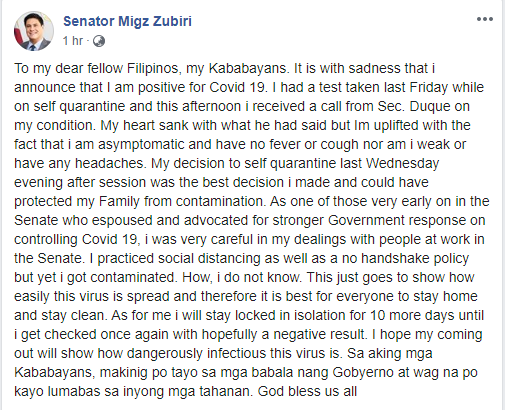
Inanunsyo mismo ni senate majority leader Juan Miguel Zubir sa kanyang facebook page ngayong Lunes lamang, Marso 16, 2020, na siya ay nagpositibo sa COVID-19 matapos ang ilang pagsusuri na ginawa sa kaniya.
Si senator Zubiri din ay ang kauna-unahang opisyal ng pamahalaan na nag-positibo sa COVID-19.
Narito ang kanyang pahayag!
“I had a test taken last Friday while on self-quarantine and this afternoon, I received a call from Sec. [Francisco] Duque [III] on my condition. My heart sank with what he had said.”
“My decision to self-quarantine last Wednesday evening after session was the best decision I made and could have protected my family from contamination.”
Hindi siya makapaniwala na nagkaroon o mahahawaan siya ng corona virus kahit pa man sinunod niya ang ‘social distancing’ na ipinatupad ng pamahalaan. Hindi nga rin daw siya nakipagkamay.
“This just goes to show how easily this virus is spread and therefore it is best for everyone to stay home and stay clean. As for me, I will stay locked in isolation for 10 more days until i get checked once again with hopefully a negative result.” dagdag ni Zubire.
Kabilang ang mga senador na sina Nancy Binay, Franklin Drilon, Sherwin Gatchalian, Panfilo Lacson, Lito Lapid, Imee Marcos, Francis Pangilinan, Ramon Revilla Jr. at Francis Tolentino sa mga sumasailalim sa self-quarantined ngayon.
Figures sent by the Bureau of Internal Revenue (BIR) to the Office of the Solicitor general (SolGen) on Friday showed ABS-CBN has far less number of employees than what the broadcast giant has been claiming.
In a letter to SolGen Jose Calida dated 21 February 2020, the BIR said ABS-CBN Corp. and ABS-CBN Convergence Inc. have a total of only 4,401 employees, way below the 11,000 the Kapamilya network has been claiming in its efforts to renew its franchise which expires 30 March.
The Internal Revenue based its findings on the Annual Information Return of Income Taxes Withheld on Compensation and Final Withholding Taxes submitted by both ABS-CBN Corp. and ABS-CBN Convergence Inc.
The BIR document showed ABS-CBN Corp. has 4,322 employees while ABS-CBN Convergence Inc. has 79 as of 31 December 2018.
This development comes ahead of a Senate committee hearing set on Monday for deliberations on the franchise renewal of the network giant with no less than Calida among those being summoned to appear.
Calida was the one who filed a quo warranto petition to the Supreme Court (SC) seeking to revoke the network’s franchise based on three grounds — offering pay-per-view services without permit;
using the franchise of a company it acquired without congressional approval; and ceding foreign control by issuing Philippine Depositary Receipts or PDR.
The petition was met with fierce opposition from the network, its supporters, some politicians and even leftist groups which led Calida to ask the High Court to issue a gag order on ABS-CBN.
The move, however, was seen by media and human rights groups as an effort to clamp down on press freedom.
High Court order
The SC, on the other hand, ordered ABS-CBN to submit its comment to the gag motion within five days.
“In accordance with due process, the Supreme Court has ordered ABS-CBN Corporation and ABS-CBN Convergence Inc. to file their respective comments within a non-extendible period of 5 days,” said SC spokesman Brian Keith Hosaka in a previous press briefing.
Calida cited as violations of sub judice some ABS-CBN news items, including a video explainer of the technical terms in the quo warranto petition including PDR.
“The statements uttered by Christian Esguerra in the video tend to influence public opinion and unfairly encourage the prejudgment of the instant case — that in the event that the petition will be granted, the Filipinos will experience a sense of unjust treatment as they would be deprived of their favorite shows in ABS-CBN,” said Calida in an earlier statement.
Other news items which Calida cited are — television reports airing the answers of ABS-CBN to the allegations, “commentaries,” as well as articles quoting various experts in the discussion of the issue.
On Friday, over 2,000 employees and artists of ABS-CBN Broadcasting Corporation took to the streets with other groups to call for the renewal of the network’s expiring franchise, with some carrying candles and placards saying “#YestoABSCBNFranchiseRenewal” around the company compound in Quezon City.
Also, groups such as the National Union of Journalists in the Philippines and Altermidya, political parties Bayan Muna and Gabriela and the University of the Philippines College of Mass Communication attended the rally.
ABS-CBN CEO and president Carlo Katigbak on Thursday said the network does not have to stop operations and they are ready to follow the legal process.
You can read and itemized all the violations that the Solicitor General Jose Calida filed before the Supreme Court against ABC-CBN. Click the link below:
SOME 22 percent of the shares of media conglomerate ABS-CBN Corp., now worth at least P3.5 billion, are owned by foreign companies, mainly the Los Angeles-based, privately owned The Capital Group, one of the world’s largest investment management firms.
Together with several other foreign firms, including the United Kingdom’s Prudential Plc (through its Singapore firm), the United States company received P1.3 billion in income out of ABS-CBN’s profits from 2015 to last year, Securities and Exchange Commission (SEC) reports show.
This is a blatant violation of Section 11, Article XVI of our Constitution: “The ownership and management of mass media shall be limited to citizens of the Philippines, or to corporations, cooperatives or associations, wholly-owned and managed by such citizens.”
This violation of the Constitution is one of the two main grounds that Solicitor General Jose Calida invoked in a request he made to the Supreme Court the other day to revoke ABS-CBN’s franchise.
In a similar constitutional violation case that Calida brought against the online news source Rappler Inc. and Rappler Holdings, he asked the SEC to revoke the two firms’ license to operate as corporations. The SEC agreed with Calida; the two firms appealed the case to the Court of Appeals.
Oligarchic
How ABS-CBN got to have substantial foreign ownership certainly looks like a case study of how oligarchic control of government is crucial for their wealth. Owned by the Marcos’ archenemies, the Eugenio Lopez clan, ABS-CBN disguised its acquisition of foreign funds when it issued though its shell company ABS-CBN Holdings (which has 36 percent of the media firm) in 2013 — at the height of its patron former president Benigno Aquino’s 3rd’s, power — P4.5 billion worth of what it called Philippine Depositary Receipts (PDRs). These entitled its holders to 36 percent of ABS-CBN Corp.’s shares the shell company had, giving them the profits from those shares.
ABS-CBN Holdings sold a huge block of these PDRs mainly to the US-based The Capital Group and subsequently to other foreign firms, with the firm reporting that 62 percent were held by foreigners. That computes to 22 percent of ABS-CBN Corp.’s shares (0.62 x 36 percent).
PDRs are a kind of security, which entitles its holder to a share of a company, as well as to any benefits from owning it. It has been a flimsy way for media companies to skirt the constitutional ban on any foreign funds in media, the legitimacy of which rests entirely on an SEC ruling or, as the case actually was during Aquino 3rd’s administration, its mere acquiescence.
PDRs as a means to cloak foreign money and even control in media firms were first used in 2012 by the Indonesian tycoon Antoni Salim to fund his MediaQuest, which became the holding company of the Philippine Star-TV 5 media conglomerate.
I had first reported such gross violation of the Constitution in 2013, but the Aquino 3rd government — of course — did nothing to ask the SEC or any court whether this was legal.*
Solicitor general
It was only when the Office of the Solicitor General (OSG) in 2016 asked the SEC to investigate if Rappler’s PDRs were in violation of the Constitution that the agency issued a ruling. The SEC upheld the solicitor general’s claim that these were unconstitutional.
One of the provisions of the SEC ruling read: “The constitutional and statutory prohibition with regard to foreign control of mass media is absolute. It means to isolate the Filipino masses from all foreign influence (even apparently ‘harmless’ ones) sent via ‘any medium of communication…’ The restriction on foreign equity prevents any scheme to grant rights attached to equity — even the guise an equity derivative.”
In that ruling, the “equity derivative” is so obviously Rappler’s PDR. It is the foreign investments’ disguise. Objective observers have agreed with the SEC: How could a corporate disguise overturn a provision of the Constitution?
Among other commentators, University of the Philippines professor Amelia Ylagan, PhD, in a column in BusinessWorld, a newspaper in the Indonesian magnate’s media empire, made this point regarding the Rappler case:
“Mass media companies here in the Philippines really must observe the all-Filipino rule for mass media in the Constitution. No ifs or buts, no indirect or backdoor sneaking in and around this. And what must not be forgotten in finance is never to invest or offer something, which you do not fully understand, unless, as the SEC implied — you precisely want to skirt the attendant issues.
PDRs
The OSG hit the nail right on the head when it quoted a maxim from Roman law: “Quando aliquid prohibetur ex directo prohibitur et per obliquum,” It means “what cannot be done directly can’t be done indirectly.” The solicitor general expounded: “If acts that cannot be legally done directly can be done indirectly, then all laws would be illusory.”
ABS-CBN had claimed that it issued the PDRs in order to raise capital it needed. One of its reports even had the gall to state that “it was to obtain foreign investments to increase their undervalued shares, and to allow foreigners to participate in mass media.”
But why didn’t it get local partners instead, or raise money in the local capital markets through bonds? The Lopezes obviously had been so possessive of ABS-CBN that they didn’t want local partners, unlike most Filipino tycoons who have struck alliances with other local magnates. They also wanted to scrimp on the costs involved in raising capital in the financial markets. “The Lopezes will be paying heavily for their reliance on a supportive government,” one magnate remarked.
I don’t think the Philippine elite will mount an attack against President Rodrigo Duterte to support ABS-CBN for their boo-boo in using PDRs as a flimsy disguise to get foreign money.
Media
Only two media companies are similarly using PDRs to get foreign money, which is violative of the Constitution: Salim’s Philippine Star-TV 5 conglomerate and GMA 7. The solicitor general’s case so far is only against ABS-CBN, encouraged by the SEC decision on Rappler. It is a forewarning to Salim and GMA 7 that they still have time to remove their PDRs to comply with the Constitution.
Salim’s media empire is puny compared to his other stakes in the country — the Manila Electric Co., PLDT Inc., Maynilad Water Services Inc., power generation firms and tollways — that he can easily give it up, and maybe even offer it to government to convert into the Philippine version of BBC, NHK or the mostly state-controlled newspapers in Singapore, South Korea and Japan.
The Ayalas have retreated, giving up control of Manila Water Co. Inc. to tycoon Enrique Razon after Duterte went after them for their reportedly onerous contract with the government. I don’t think GMA 7 will try to oust Duterte. It’s likely to buy back its PDRs from foreign holders of these, and then sell these to locals, especially since GMA 7 would be so attractive as an investment when ABS-CBN closes down.
Few are betting that the Supreme Court will rule against the solicitor general’s complaint, with its track record of leaning to strict adherence to the Constitution, especially its nationalist provisions.
The only other way the Supreme Court could rule is, as in the case of the case brought against PLDT for violating the Constitution’s limits on foreign equity in public utilities, is to ask the SEC to decide on it instead. Guess how the SEC would rule, given the Rappler case?
How will the PDR holders, especially the foreigners, react if the Supreme Court rules that the securities they bought for P4.5 billion are illegal, as these violate the Constitution? Corporate Armageddon for ABS-CBN.
With the Yellow Cult’s demise, its main propaganda machine since 1986 will also likely disintegrate.
*Colossal Deception: How Foreigners Control Our Telecoms Sector: A Case Study of Corruption, Cronyism and Regulatory Capture in the Philippines. Available through Amazon.com
Source: Manila times
Email: tiglao.manilatimes@gmail.com Facebook: Rigoberto Tiglao Twitter: @bobitiglao Book orders: www.rigobertotiglao.com/debunked
CLARK FREEPORT 09 FEBRUARY 2020 – The Department of Foreign Affairs (DFA) brought back to the Philippines today a total of 30 Filipinos who wished to return home from Wuhan City, ground zero of the 2019 Novel Coronavirus Acute Respiratory Disease (2019-nCoV ARD).
The repatriated Filipinos onboard the chartered flight which landed at the Haribon Hangar in Clark Air Base included 29 adults and one infant.
Together with the repatriates were a 10-member team from the Philippines which included two members from the Philippine Consulate General in Shanghai, three members from the DFA Office of the Undersecretary for Migrant Workers’ Affairs (OUMWA), and five medical team members from the Department of Health (DOH).
Upon their arrival, the Filipinos were safely and swiftly transferred from the plane into their dedicated buses, and brought to the Athlete’s Village in New Clark City in Tarlac which will be their home for the 14-day quarantine period.
The DFA made an initial call for the repatriation of Filipino nationals in China on 28 January 2020, which was facilitated by the Philippine Embassy in Beijing and the Philippine Consulate General in Shanghai, the Foreign Service Post with jurisdiction over Wuhan city in Hubei province.
The Embassy and the Consulate liaised with Chinese authorities to facilitate the operation. This past week, two representatives from the Consulate General in Shanghai had to hurdle several border provinces’ clearances along their arduous two-day land travel to Wuhan City to coordinate with the Filipino community and the Foreign Affairs Office in Hubei Province.
Meanwhile, the team from the DFA Home Office in Manila flew into Wuhan City Saturday night, completing the team ensuring the safe return of the Filipinos.
Atty. Jude Sabio who filed a complaint and information before the International Criminal Court against President Duterte has executed , signed and sworn an affidavit and statement withdrawing the ICC case saying that he did not approve what Trillanes and other LP personalities have resorted to aimed at besmirching the honor of the President.
Now, we can put the fake news that Senator Bong Go has anything to do with Joyride, and the implications that he has been playing an unfair role against pioneer servicer Angkas, to rest. The fake news got a little bit right – it was a Senator putting his nose where it doesn’t belong. But it’s Senator Koko Pimentel, not Senator Bong Go, who backed Joyride.
Senator Koko is in hot water over a recently surfaced old letter which revealed his support for motorcycle taxi hailing app Joyride. The letter expressed the Senator’s endorsement of Joyride to be included in the already underway motorcycle taxi initial pilot run. Thankfully, the Department of Transportation did not heed the inappropriate endorsement.
The letter was revealed during a press briefing held by the Lawyers for Commuter Safety and Protection (LCSP).
“Anong kinalaman ng isang senador sa approval ng isang government agency sa kanilang application to be included in the pilot program? Nababahiran ng dungis ‘yung ginawa ng senador,” said Mangahas.
The LCSP further cleared Senator Bong Go of any involvement in Joyride, putting the final nail in the coffin for fake news purveyors who were quick to blame even the faintest whiff of government wrongdoing on the President’s ally.
In fact, it was the allegations leveled against Go which moved the LCSP to investigate into the matter. During this inquiry, the lawyer group uncovered a copy of Pimentel’s endorsement letter.
Further evidence of Pimentel’s involvement was presented during the press briefing, including a Google Maps photo which placed Pimentel’s photo and signature proudly displayed next to the “huge” Marikina site which soon became Joyride’s onboarding facility.
According to Atty. Trixie Mangahas, Pimentel may have violated Republic Act No. 6713 or the Code of Conduct and Ethical Standards for Public Officials and Employees. Though Pimentel is a Senator, he is not free to interfere in the affairs of the Executive branch. The Department of Transportation rightly ignored his endorsement as this was a grave overstep into the implementing agency’s business.
Pimentel could have also violated Section 3(a) of Republic Act No. 3019 or the Anti-Graft and Corrupt Practices Act for attempting to act as a go-between for Joyride and the Department of Transportation. Unfortunately for Pimentel, his efforts failed to gain a positive response from the Department of Transportation and Secretary Tugade.